The Podcast
Conversations with people who've sat with uncertainty long enough to learn something from it—ministers and therapists, writers and researchers… anyone who's discovered that the questions matter more than the answers.
Episode 11: “Trust Without Reservation” | Kathryn Cornelius
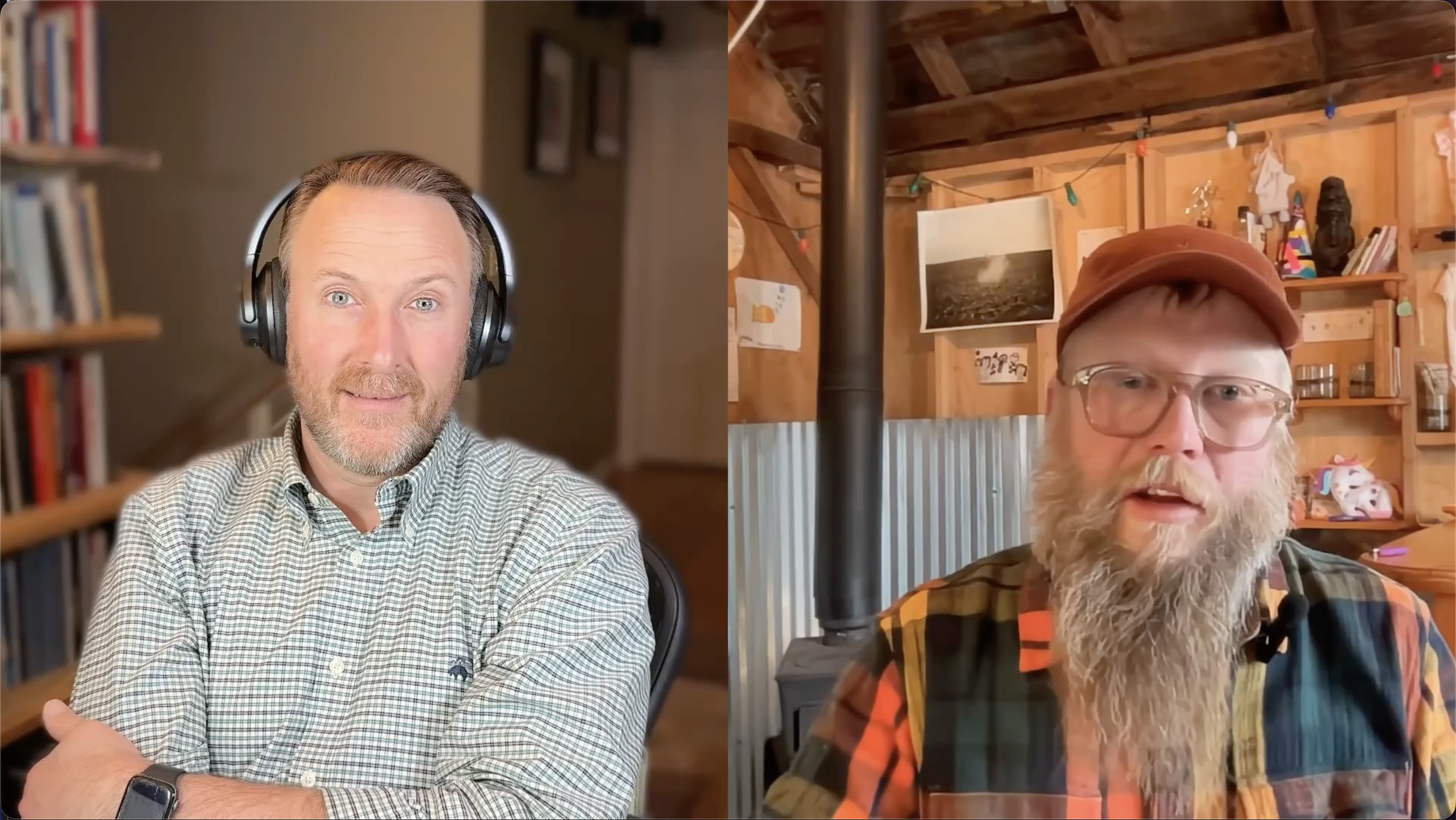
Kathryn Cornelius has been a performance artist with exhibitions in Berlin, Rome, Naples, and Buenos Aires; a consultant at a major international firm; and the founder of Whole Human Alchemy, a coaching and healing practice she built from breathwork, internal family systems work, and twenty-five years of moving between art, enterprise, and her own hard-won recovery. She has also been through things that are harder to name than any of that — what she calls, without drama, "movie-level shit." She and I knew each other at Georgetown twenty years ago, in the years when high theory got malleable at three in the morning, and then didn't speak for two decades. We recorded this across two sessions. We talk about the difference between discipline as punishment and discipline as devotion; a question about faith on a porch in New Hampshire at three in the morning; a crime in Spain; and what it looks like to choose to be here. Also: I stopped hosting somewhere in the second session and just got into the conversation.
Episode 10: “Carry the Zero” | Ryan Eggensperger
Ryan Eggensperger is a playwright, DJ, actor, and tour guide who has been doing the same thing every morning for twenty years: sitting with a blank page, not filling it immediately, not resenting the blankness. He calls it: carrying the zero. We met when he was directing a play at my kids' school. One night, we sat on the post office lawn until eleven. Here, we talk about the journal entry that changed his relationship to his own talent ("No more mongrel genius"); a cave in the Black Hills where the earth breathes cool air through a fourteen-inch hole in a rock; and what it looks like to actually do the thing, rather than to prepare to do it. Also: he asked me just about the best question I've been asked on this show. I'm still sitting with my answer.
Episode 9: “Confidently Irreverent” | Jessie Rack
Jessie Rack is an ecologist, science writer, and teacher whose first degree was in music. Her career — Princeton's Writing Program, fieldwork in Iceland, a teaching professorship in Arizona — looks like a random walk. From the inside, it's been a sustained inquiry into productive uncertainty: follow where the categories break down, because that's where you find out what they were doing. We talk about consciousness, free will, and what a psychic told her at a party that she still thinks about. Also: a job interview at 9pm in Icelandic midsummer daylight, and the sentence in a paper about scorpion eyes that made her write a poem.
Episode 8: “Wild by Design” | Gwyneth Hagan
Gwyneth Hagan spent a decade as a school designer at EL Education, helping build the architecture for how learning communities grow — and watching a mission-driven organization make the transition from forty people on a shared vision to a system precise enough to be taught to people who hadn't lived it. Wild Design for Learning, her forthcoming book, is her answer to what gets lost in that transition. Organized around six patterns from the natural world, it asks what schooling might look like if the forest, not the factory, were the model. This conversation begins on a farm in coastal Maine and finds its way through a spider, a Mary Oliver line, and the question of what it actually costs to risk something that matters.
Episode 7: “Father Time is Undefeated” | Steve Filosa
Steve Filosa spent twenty years building Prep at Pingree — a scholarship and academic enrichment program in Essex, Massachusetts designed, from the start, to outlast him. Then he handed over the keys and started over: a consulting practice for donors and nonprofits, from scratch, at fifty, during a pandemic. We talk about what it takes to build something that doesn't scale, what he found on the other side of the leap, and what peace actually feels like from the inside.
Episode 6: “Certainty Kills Civic Imagination” | Michael Rohd
Michael Rohd directs the Collaborative for Civic Imagination at the University of Montana and has spent thirty-five years building theater-based processes that bring communities into genuine dialogue about the things that most divide them. I asked what forecloses collective imagination before it begins — what kills it before it starts. He named four things. The first one stopped me. And the pairing — what the remedy actually is, once you've named the problem — turned out to be one of the things I've been trying to understand all season.
Episode 5: “Not the Hardest Thing We’ve Done” | Salmaan Kamal
Salmaan Kamal is an internal medicine physician, addiction specialist, and researcher who provides primary care to veterans experiencing homelessness — in the clinic, on the street, and in their homes. He went to Princeton, where we met as undergraduates, then returned home to Alabama for medical school and residency before a stint at UCLA. We talk about a pattern I wanted to understand: at every major inflection point, he chose proximity to need and to family over prestige — and each time, the next choice got easier. Also: what it actually takes to put your phone away at 6pm, why camping might be the prototype for everything, and what happens when the constraint that's been shaping your life disappears.
Episode 4: “A Shrine to Something” | Alison Dilworth
Alison Dilworth is a Philadelphia-based artist, muralist, and shrine-maker. We talk about what it means to hold things — grief, love, other people's stories, a kid running toward traffic — and what it costs to be genuinely present to any of it. A conversation about bearing witness, rites of passage, and the broken girl who got her here. See also: https://www.instagram.com/brainsoulface/.
Episode 3: "On the Other Side of Boredom" | Adam Ekberg
Photographer Adam Ekberg spent two and a half years launching a lawn chair with a homemade catapult, thirty consecutive nights photographing a disco ball on a mountaintop, and hours watching ants with his neighbor. We talk about what happens on the other side of boredom — and why the experience of being there might be all the stuff.
[Read the companion essay: “On the Other Side of Boredom”]
Episode 2: "Everything Is Relational" | Kanwal Singh
Kanwal Singh is a cornea surgeon, Fulbright scholar, and global health educator who has spent his career building connections between American academic medicine and under-resourced communities around the world. He's also a friend — we met when he was a freshman at Princeton and I was working in residential life, and I've watched him navigate the distance between idealism and institutions ever since. We talk about what it means to align your work with your faith, what he learned about strategy and relationships as a young trustee on Princeton's board, and why he's come to believe that "soft relations carry so much more weight" than procedural wins. Also: the day everything went sideways in Cairo and he found himself sitting cross-legged in borrowed slippers, practicing patience because there was nothing else to do.
Episode 1: "Companionable Silence” | Lynn Casteel Harper
Lynn Casteel Harper is a minister, hospital chaplain, and author of On Vanishing: Mortality, Dementia, and What It Means to Disappear. She spent years sitting with people living with dementia — past the edge of language — and learned something there that couldn't be learned anywhere else. We talk about what silence looks like when it isn't empty, why gentleness turns out to be a harder kind of strength than it sounds, and what the trees in Biosphere 2 have to do with learning to bend without losing yourself. A conversation about presence, power, and what stays when certainty is gone.